Service Hotline:86-17346269651 /

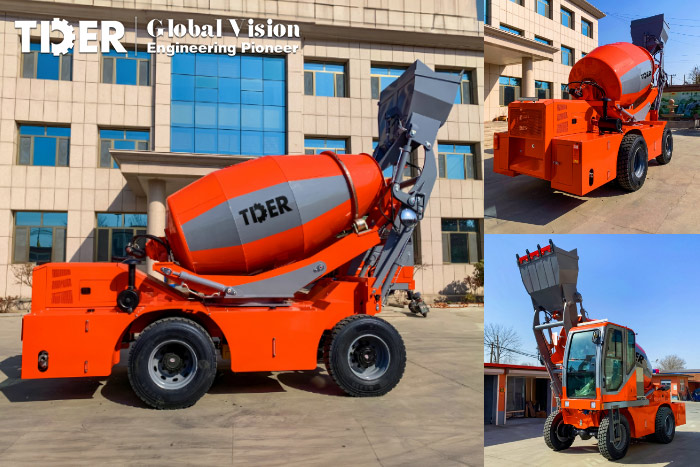
With global infrastructure development continuing, self-loading concrete mixers are increasingly applied in rural road construction, small-scale infrastructure, and dispersed projects due to their “load–measure–mix–transport” integrated capability.
At the same time, as construction environments vary, the equipment is divided into two chassis types: “integrated” and “articulated,” with significant differences in load-bearing capacity and terrain adaptability. Incorrect selection may easily lead to operational inefficiency.
Against this backdrop, TDER provides a systematic selection approach and application guidance through multi-structure combinations and scenario-based configurations.
I. Integrated vs. Articulated: Selecting the Right Chassis for Different Construction Conditions
1. Integrated Chassis: Emphasising Heavy-Duty Rigidity and Continuous Operation
Integrated self-loading mixers feature a single-frame design, integrating power, drive, and mixing systems into one cohesive structure. This design enhances structural rigidity and heavy-load stability, making it suitable for continuous operation scenarios.
For example, the TDER 4.2m³ integrated self-loading mixer TCM42 offers the following characteristics:
(1) Structural and Load Performance
The integrated frame improves overall rigidity. Load paths are direct and clear, enhancing torsional and fatigue resistance. This design ensures structural stability and operational reliability under heavy loads, continuous vibration, and dusty or complex construction conditions.
(2) Operational Capability
Equipped with a 270° rotating discharge system, the mixer enables continuous concrete placement on site. The integrated chassis supports high-volume, continuous production and transport, matching high-intensity, uninterrupted work schedules.
(3) Suitable Work Conditions
Integrated mixers are ideal for large construction sites, roads, municipal infrastructure, and rural concentrated projects. Where routes are relatively fixed and relocation frequency is low, their continuous operation potential can be fully realised.
(4) Structural Limitations
Due to longer wheelbase, integrated chassis have limited manoeuvrability on narrow roads, sharp turns, or complex terrain, requiring a minimum standard of site conditions.
Overall, the integrated chassis prioritises stable output, suitable for heavy-duty continuous operation.
2. Articulated Chassis: For Complex Terrain and High-Mobility Operations
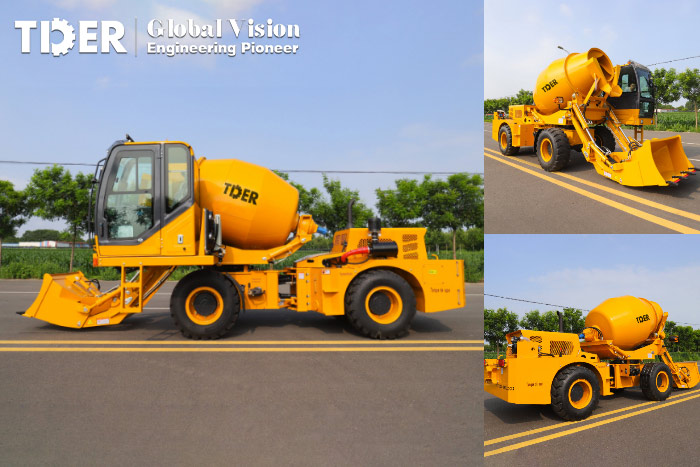
Articulated self-loading mixers employ a front–rear hinged steering frame, offering a smaller turning radius and superior terrain adaptability. The design focuses on passability and manoeuvrability.
For example, the TDER 2.6m³ articulated self-loading mixer TCM26 exhibits the following features:
(1) Passability and Mobility
The hinged frame allows relative motion between front and rear sections over uneven terrain, enabling the vehicle to maintain four-wheel contact on muddy, uneven, unpaved roads or temporary paths. This enhances traction and reduces wheel slip risk.
(2) Operational Adaptability
The central articulated steering provides a small turning radius, allowing the vehicle to navigate narrow access roads, mountainous paths, or dense construction zones without frequent reversing, improving manoeuvrability and workflow efficiency in confined spaces.
(3) Suitable Work Conditions
Articulated mixers are ideal for small-volume, on-site batching and immediate pouring, particularly where construction points are dispersed, road conditions are poor, and frequent relocation is required. Dependence on external transport is reduced, improving overall workflow.
(4) Structural Limitations
The hinged connection generally offers lower torsional rigidity and load stability during heavy, high-volume transport compared to integrated models. Long-distance, high-speed driving may produce noticeable body sway, affecting ride smoothness and comfort.
Overall, the articulated chassis emphasises environmental adaptability, excelling in complex terrain and low-standard road conditions.
II. Fixed Cab vs. Synchronous Rotating Cab: Choosing the Appropriate Operation Mode
As construction becomes more precise, self-loading mixers are evolving in operational methods, with “enhanced visibility” and “bi-directional operation” emerging as key trends.
For example, the TDER 3.5m³ self-loading mixers TCM35A and TCM35C illustrate two typical technical approaches.
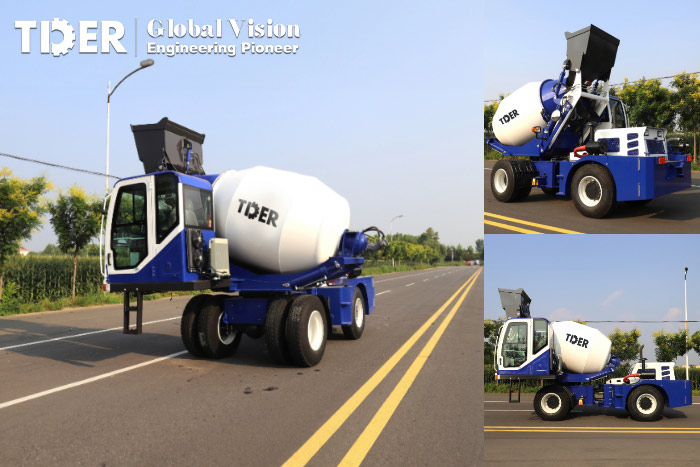
1. Fixed Cab Structure: TCM35A
The cab is fixed to the front frame, maintaining a stable orientation independent of the drum rotation. Drivers benefit from consistent directionality and spatial reference, with clearer visibility and less operational interference.
The drum supports 270° unidirectional discharge, allowing continuous placement during travel. In linear projects such as canal construction, “fixed-angle discharge + constant-speed travel” improves operational continuity.
The fixed cab structure excels in stable operation and straightforward workflow, suited to linear or routine construction environments.
2. Synchronous Rotating Cab Structure: TCM35C
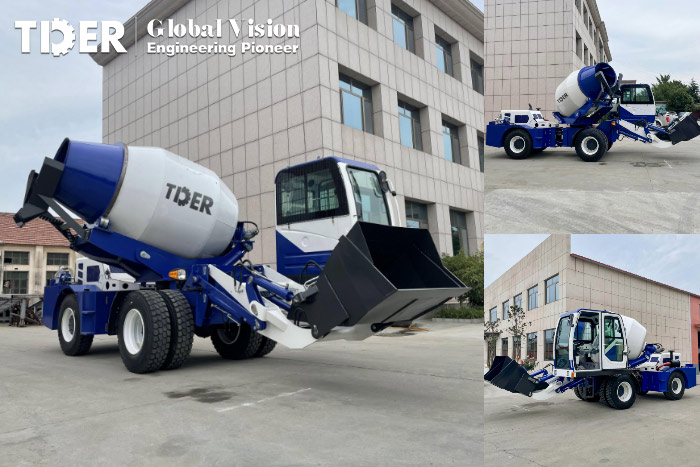
The cab rotates synchronously with the drum, allowing 90° left and right rotation for 180° discharge coverage.
This design enhances discharge visibility, enabling operators to monitor concrete thickness and distribution in real time, improving placement precision. Bi-directional driving is supported, allowing back-and-forth operation on mountain roads, narrow sites, or locations without turning space, reducing site dependency.
The synchronous rotating cab improves visibility control and operational efficiency in complex environments, ideal for constrained sites, mountainous areas, and high-frequency operation scenarios.
III. Differentiated Advantages of TDER Self-Loading Mixers
Beyond chassis and cab selection, overseas customers prioritise aftermarket performance, safety, and maintenance convenience in long-term operations. TDER focuses on technical innovation rather than low-price competition, offering multidimensional core value:
1. Core Operating System: Drum and Support Structure
The drum uses epoxy primer protection and manganese steel for corrosion and wear resistance. Internal blades employ a “multi-blade + spiral guide + paddle” design, improving feed efficiency, mixing uniformity, and continuous discharge, reducing segregation. Dual support wheels optimise force distribution and rotation stability, ensuring smooth operation.
2. Market-Differentiated Configuration: Standard Luxury Cab and Automotive-Grade Wiring
TDER is the only brand offering a wide-body luxury cab as standard. The cabin is 12 cm wider than competitors, with shock-absorbing seats and air conditioning for comfort in multiple climates. The electrical system is upgraded with automotive-grade wiring for rain, moisture, and fire resistance, reducing fire and system failure risks.
3. Maintenance Efficiency Optimisation: Front-Centralised Lubrication System
Daily maintenance is simplified by centralising lubrication points at the front, reducing chassis downtime, improving maintenance efficiency, and lowering servicing costs.
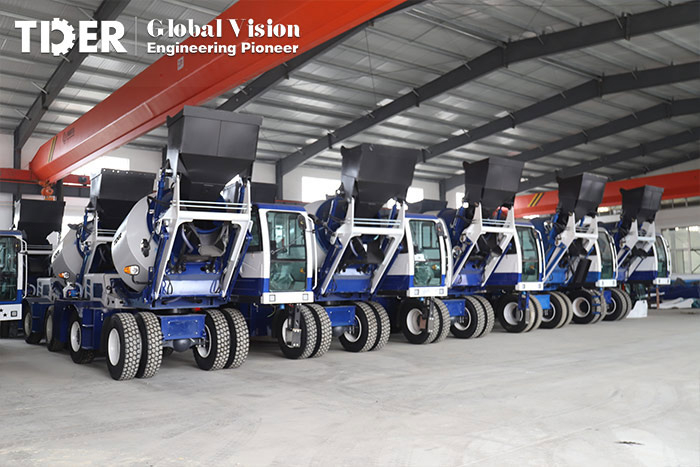
In conclusion, selecting a self-loading mixer fundamentally depends on work conditions, transport, and operational intensity. Integrated and articulated chassis suit different terrains and workloads; fixed and rotating cabs match distinct operation modes. TDER provides systematic solutions combining structural configurations and operation modes for varying work environments, offering clear selection guidance and improving operational stability and equipment matching accuracy.
 2003- Xiamen TDER Industrial Co., Ltd. All Rights Reserved.